 ®

The advertiser pays for what aired
Every play booked is matched to a play logged. A missed play is made good or refunded, so the balance only pays for airtime that happened.
Every play writes its own record on the machine beside the screen: what aired, where and when, with a CCTV clip attached. This page shows what each side receives from that one record, how the proof chain works, and why the video never leaves the site.
The advertiser sees what aired, where and when, with the evidence attached. The media owner sees every screen, every play and every rupiah in one dashboard. Same data, two views, and nobody has to take anyone’s word for it.

For advertisers Personal · Brand & Agency
Verified plays, timestamps, CCTV clips and a counted audience in one report you can hand straight to a client.
For media owners Operator · Partner
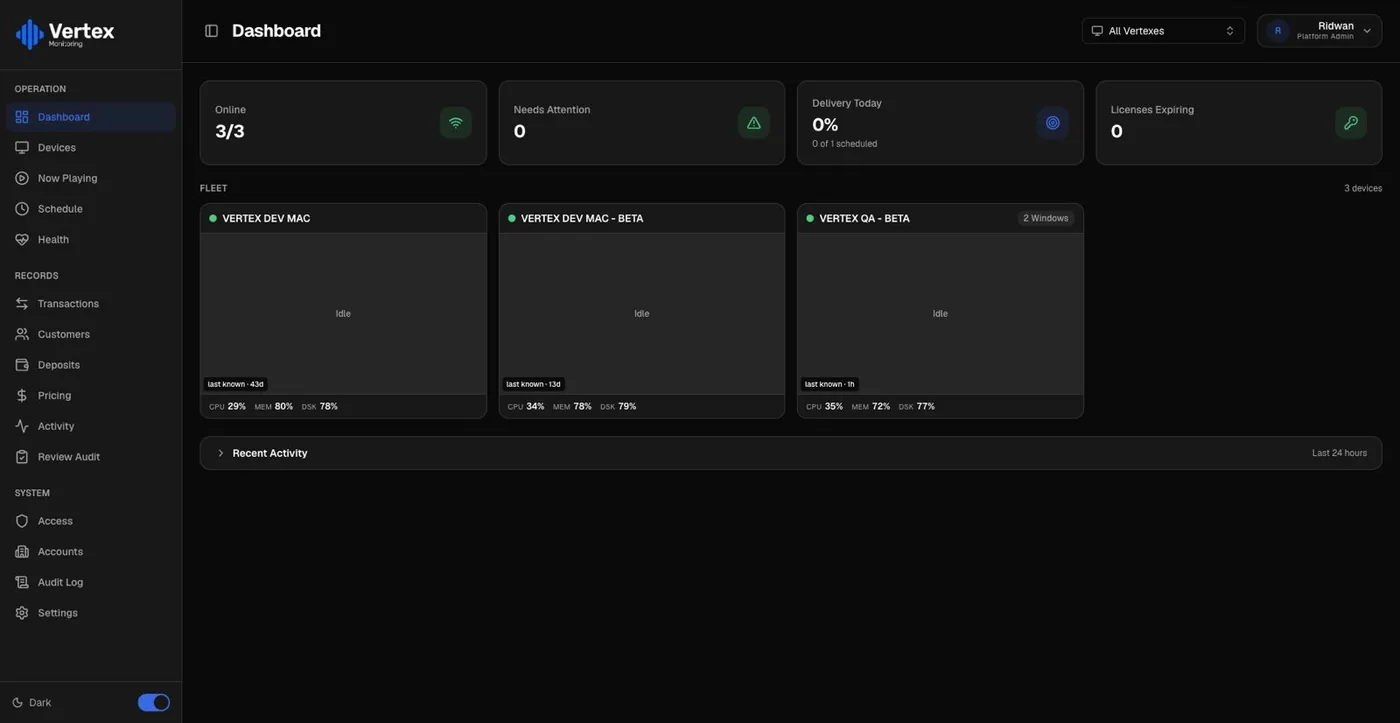
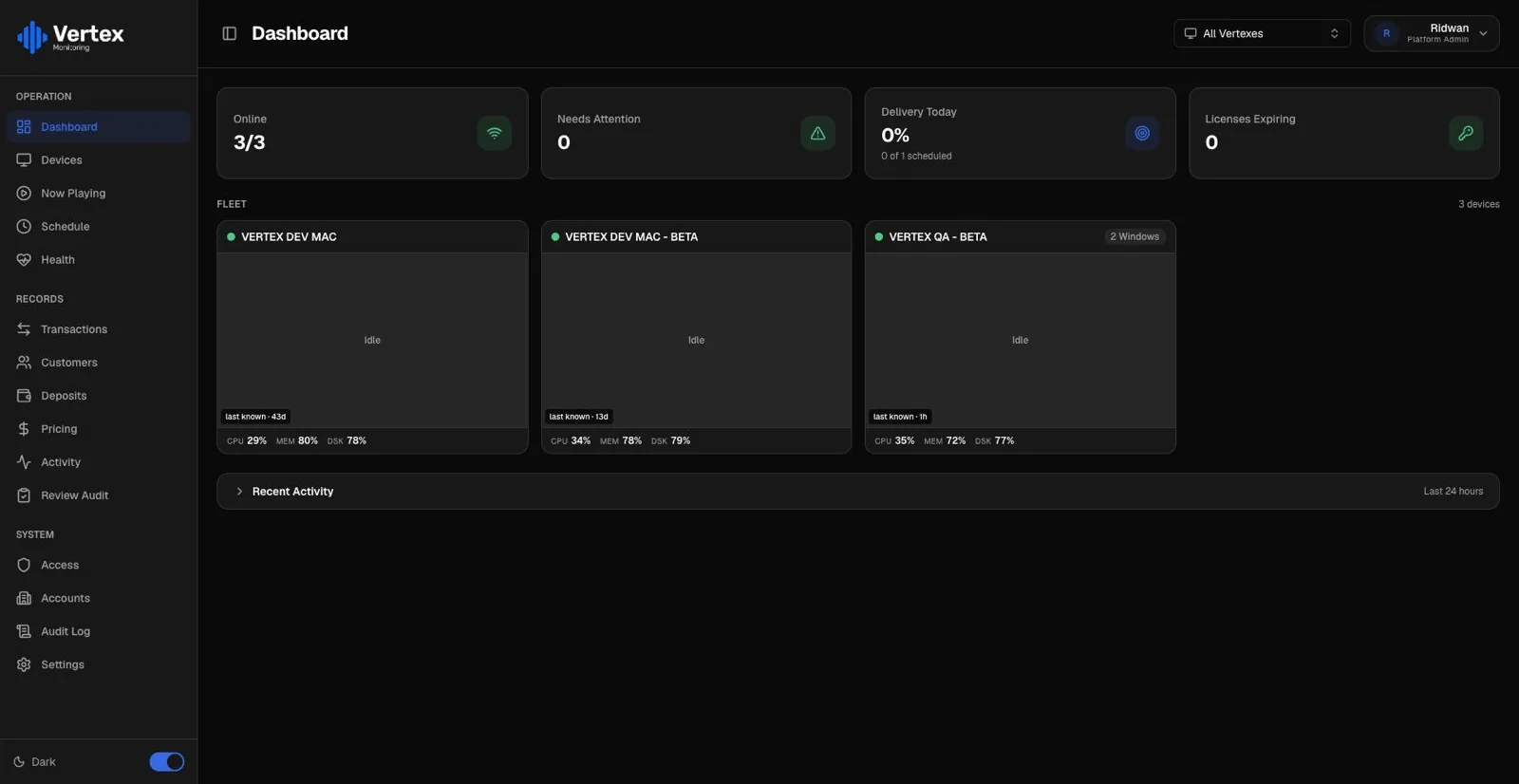
Every screen’s status with failures on top, plus live plays and proof rate. Run the network from anywhere.
Personal advertisers, brands and agencies receive the same thing: a campaign proof report that answers what aired, where, when and in front of whom.
Every line in the report comes from the player’s own log, not from a person’s memory or a photo taken once. It is ready to export and attach to a client report or an invoice.
Operators and partners see every screen they run in one dashboard, from anywhere, before a client has to call.
Vertex Monitoring gathers the status of every Vertex Player in the field. Screens that need attention rise to the top on their own, so the morning check starts with the problem, not with the alphabet.
Out-of-home was hard to trust because the proof was made by people after the fact. When the machine writes the proof at the moment of airing, each side gets something it never had.
Every play booked is matched to a play logged. A missed play is made good or refunded, so the balance only pays for airtime that happened.

A proof report and a counted audience turn a busy location into a figure a buyer can check, and a reason to come back.

There is nothing to reconcile at the end of the month. A question about a play is answered by the log, not by memory.
Four links, each written by a machine and sealed to the one before it.
The spot appears on screen at its scheduled time, aired from the player’s local storage after QC approval.
At that second the player writes the play to its own log. No one types it, and no one can type it later.
The player records a clip from an RTSP CCTV camera that sees the screen and seals it to the log entry.
The record syncs to the cloud and appears in the advertiser’s report and the owner’s dashboard. Where a camera counts, the audience at that point joins the report.
Proof of play needs an RTSP-capable CCTV camera on site, supplied by the media owner. Audience counting needs a camera installed at that point. Figures in the report and dashboard examples on this page are illustrative.
Audience counting runs on a machine at the site. Soca Insight On-Premise reads the camera, counts people and vehicles, and sends on only the numbers. The footage used for counting never leaves the location.
Video processed on site. Only the numbers leave.
A photo shows that a screen showed something once. A log written by the player at the second of airing covers every play, with a CCTV clip to back it up.
The media owner. Proof of play needs an RTSP-capable CCTV camera that sees the screen. Audience counting needs a camera installed at the point.
No. An advertiser can see that a slot is taken, never whose it is or what it shows. Financial data such as transactions and balances is visible only to its owner.
Status comes from the device’s own reports. A device that shuts down suddenly keeps its last reported status until a new report arrives. Meanwhile the player keeps its schedule locally and its logs sync when it is back.
Yes. With Qüota Placement, one play is one 15-second airing with proof of play included, visible in the app at any time.
 Vertex MonitoringOne fleet grid for every videotron you run. The screen that fails rises to the top.Vertex PlayerThe CMS and player beside every videotron. It keeps airing when the internet drops.
 Soca Insight On-PremiseCounts people and vehicles from the cameras already at your site. The video never leaves the machine.
 Brand & AgencyPlan across cities, buy by the play, and report with verified plays and a counted audience.

See a proof report and the fleet dashboard on live data in a 30-minute demo.