 ®

Fleet
Media owners
Run more than a handful of videotrons and see every one of them from the office, sorted by what needs you.

Know which screen is failing before your client calls.
A cloud dashboard that gathers the status of every videotron you run. Each Vertex Player reports in, and the devices that need attention climb to the top row by themselves.
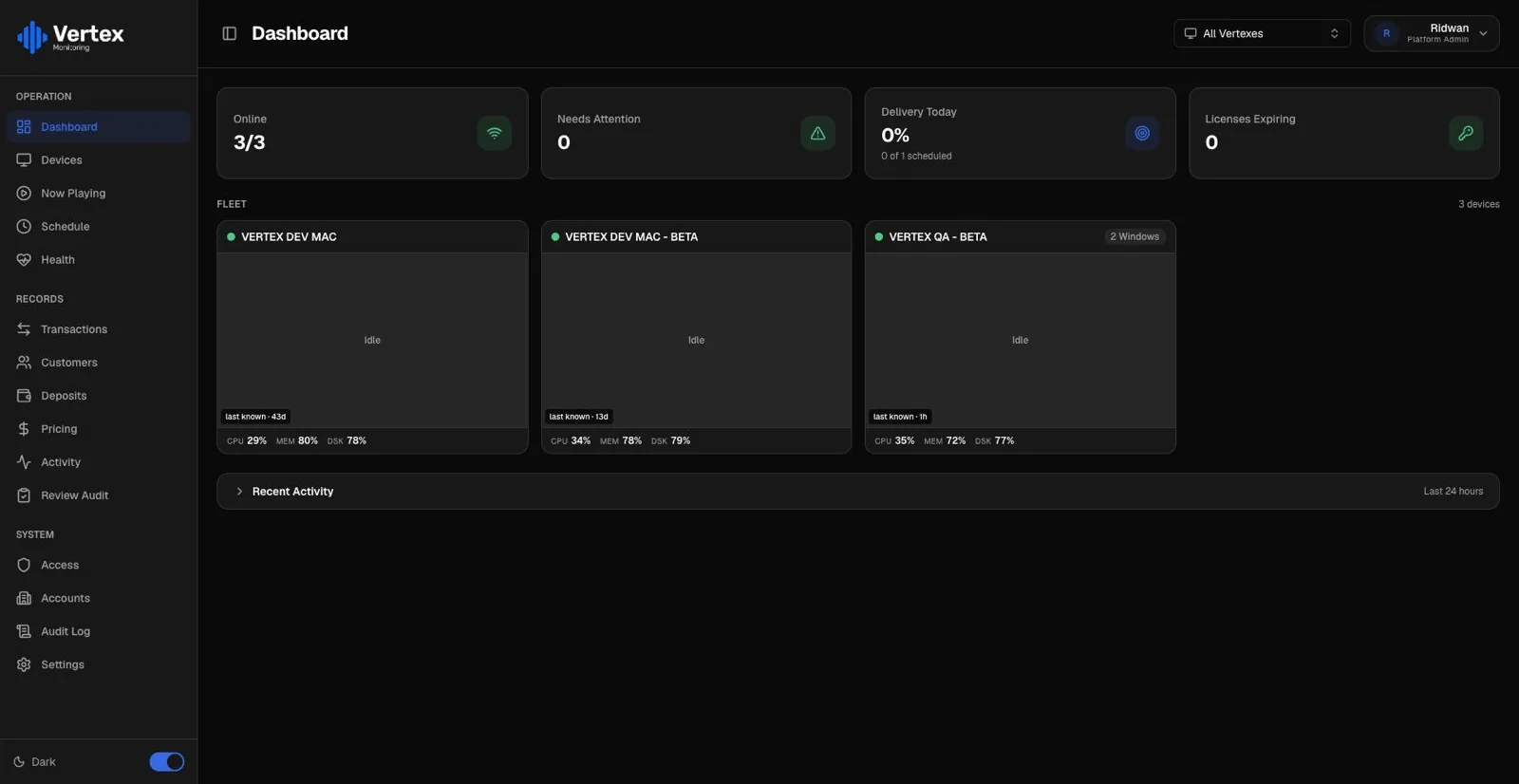
The fleet grid is sorted failing first, not by name. The screen that needs you is the first one you see.
A licence that expires within 30 days puts its device on the attention list, long before the screen stops.
CPU, memory, temperature and connection for every machine, reported by the player itself.
Each advertiser signs in to a separate view and sees only their own campaigns, plays and payments.
Vertex Monitoring collects what each Vertex Player reports, stores it and shows it to the right people. Nothing else in the field has to change.
Every device has a tile with its status badge. A device needs attention when it is offline or when its licence expires within 30 days, and it moves up the grid on its own. High CPU or memory changes the order, it never raises a false alarm.
Each Vertex Player sends a heartbeat, the freshness of its content and a preview thumbnail of what is on screen. Reports that arrive late and out of order are recognised by their timestamp and set aside, so the dashboard never steps back in time.
One videotron can serve many advertisers. Each sees the full timeline, so they know how busy the screen is, but the names and visuals of other campaigns are masked in the database itself. Payments and deposits of others never appear at all.
The platform admin registers each videotron and grants or revokes access to an account. Account admins add their own read-only viewers. Sign-in uses a one-time password, and every action taken in the cloud is written to an activity log.
A few rules, applied the same way to every device, so the grid means the same thing every morning.
Vertex Monitoring only receives. Devices push their reports to a single entry point, and the cloud never opens a connection back to a machine in the field. That leaves no door open on your network.
Status is what the device says about itself. If a machine loses power without warning, its last status stays on the grid until a new report arrives. Monitoring is visual: the grid and its badges are where your team looks.
Schedule, rates and balance live on the machine at the site.
Vertex Monitoring is the watch layer of the Kliktron AOS. Vertex Player airs, Vertex Cloud delivers, Vertex Monitoring tells you how it went.
Run more than a handful of videotrons and see every one of them from the office, sorted by what needs you.

Know which site to visit before you leave: offline machines, ageing licences and hot hardware are already at the top.

Give each client a login of their own. They see the screens they air on, their plays and their payments, and nothing that belongs to anyone else.
One price per monitored device per month. The tier follows the number of devices you register.
1 to 10 devices · 90-day log retention
11 to 50 devices · 90-day log retention
51 to 200 devices · 90-day log retention
More than 200 devices · 90-day log retention
Devices are counted from the units registered as active in the current month. Online status comes from the device report, and monitoring is passive. SLA follows the contract agreement.
Prices exclude 11% VAT. US dollar prices are converted from rupiah at Rp 18,000 = $1; invoices are issued in rupiah.
Not today. Monitoring is passive: devices that need attention move to the top of the fleet grid, with a badge, so your team sees them first when they open the dashboard.
Status is taken from the device report, not guessed from silence. A machine that loses power cannot report, so its last status stays until it sends a new heartbeat.
Videotrons that run Vertex Player. The player sends the telemetry, so there is no extra agent to install on the machine.
Yes. Each advertiser gets an account with its own admin and read-only viewers. They see the occupancy of the screens they use, their own campaigns, plays and payments, and the health of those screens.
Every plan keeps device logs for 90 days, whatever the size of your fleet.
Vertex PlayerThe CMS and player beside every videotron. It keeps airing when the internet drops.Vertex CloudSchedules, content and licences for Vertex screens across sites. Soca Insight CloudDetection jobs run on a network of partner GPUs and come back as audience analytics.Media OwnerRun, monitor and monetise your screens: offline-first airing, a fleet dashboard and retail sales of idle airtime.

See your fleet on one grid in a 30-minute demo.